Enquiry form
A Suite of Fantasy Furniture, Michelangelo Pergolesi
Italy, circa 1790
Thank you! Your submission has been received!
Oops! Something went wrong while submitting the form.

for enquiries contact: contact@mallettantiques.com | +44 020 7839 4747

Italy, circa 1790
Chairs Height: 38 ¾ in (98.4 cm) Width: 18 in (45.7 cm) Depth: 16 ¼ (41 cm) Table Height: 36 in (91.4 cm) Width: 39 in (99.1 cm) Depth: 19 in (48.3 cm)

Italy, circa 1790
Chairs Height: 38 ¾ in (98.4 cm) Width: 18 in (45.7 cm) Depth: 16 ¼ (41 cm) Table Height: 36 in (91.4 cm) Width: 39 in (99.1 cm) Depth: 19 in (48.3 cm)
Countess Mona Bismarck (1897-1983), villa il Fortino, Capri; sold Sotheby’s Italy house sale, Florence, Palazzo Capponi, 6-7 April 1987
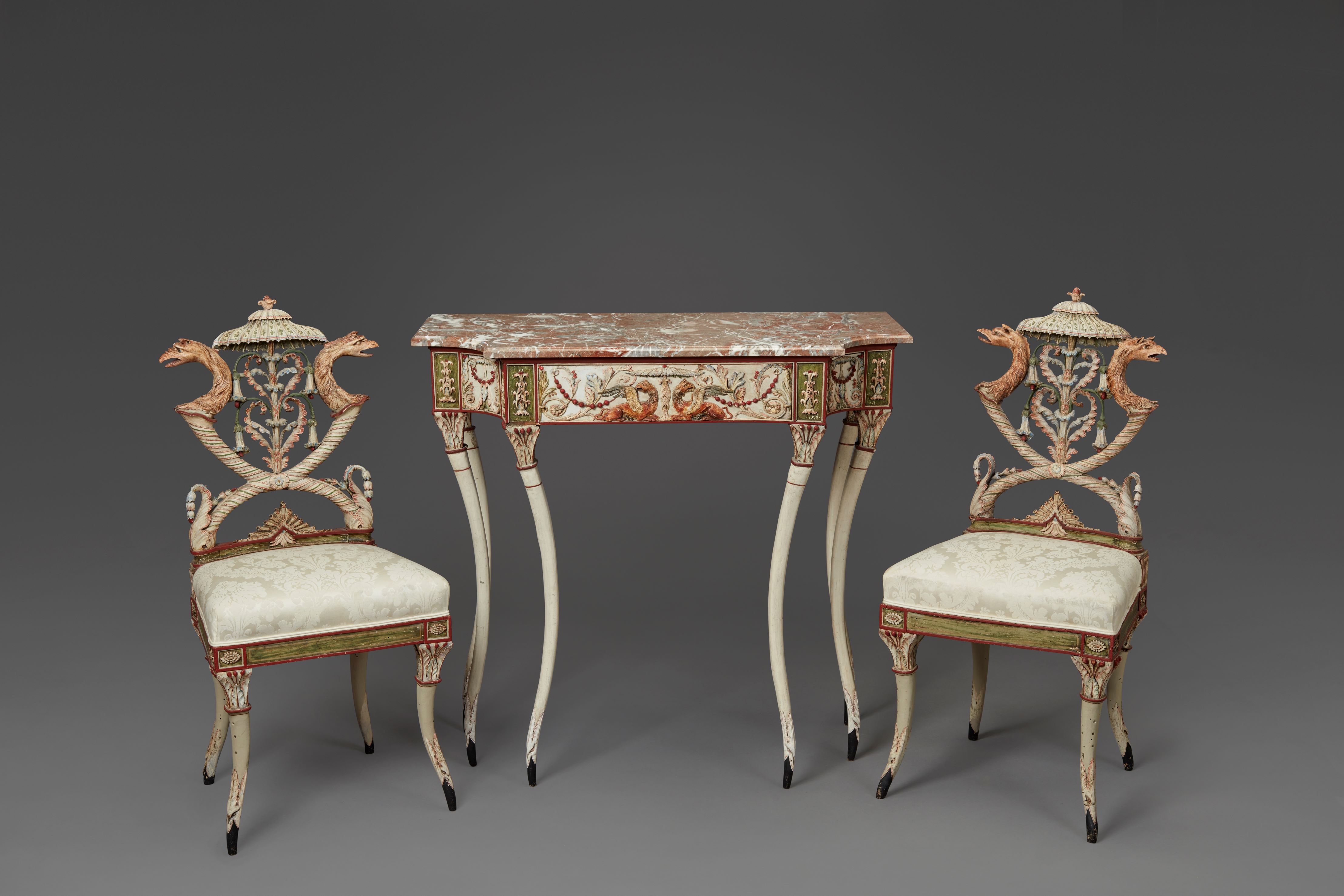
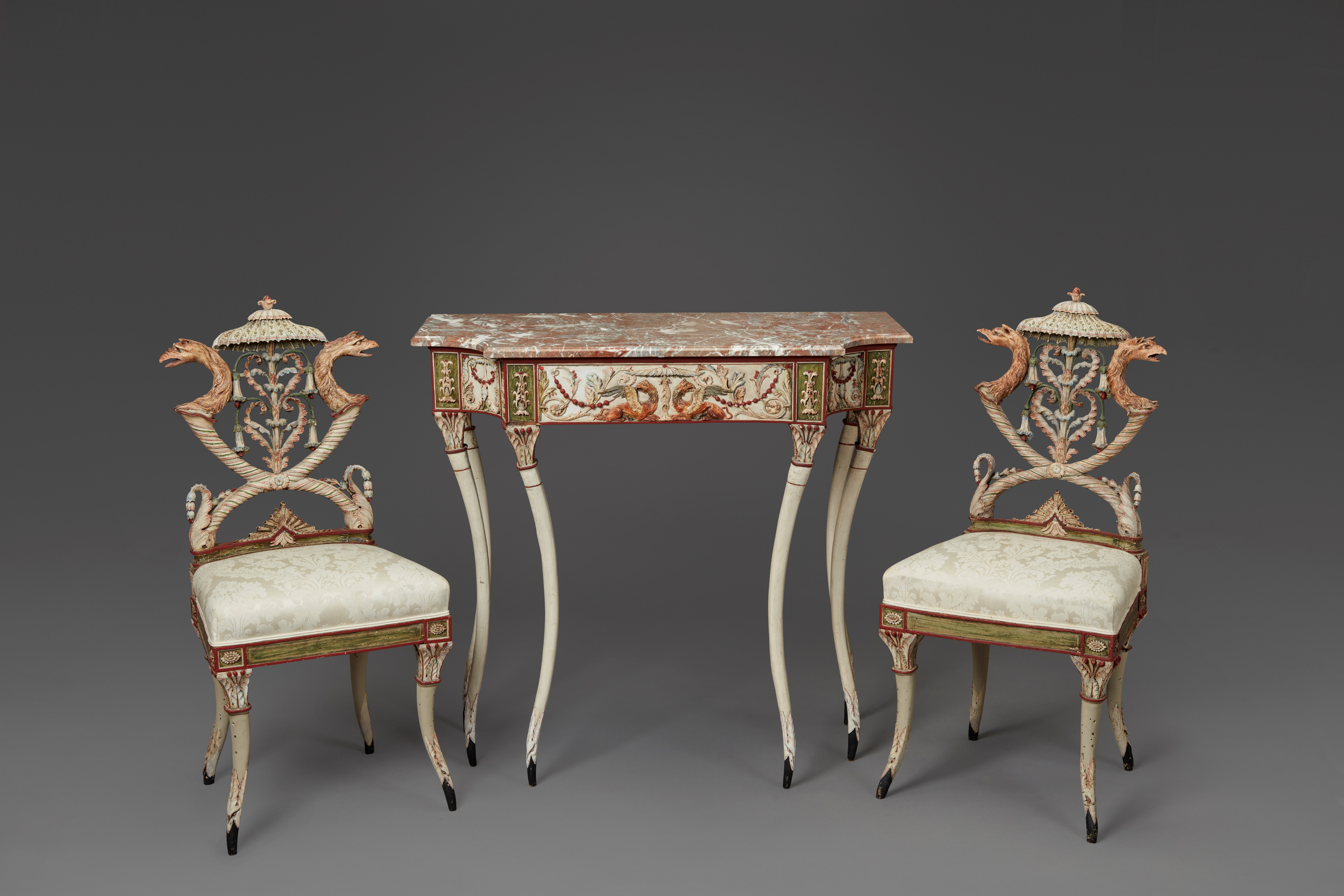
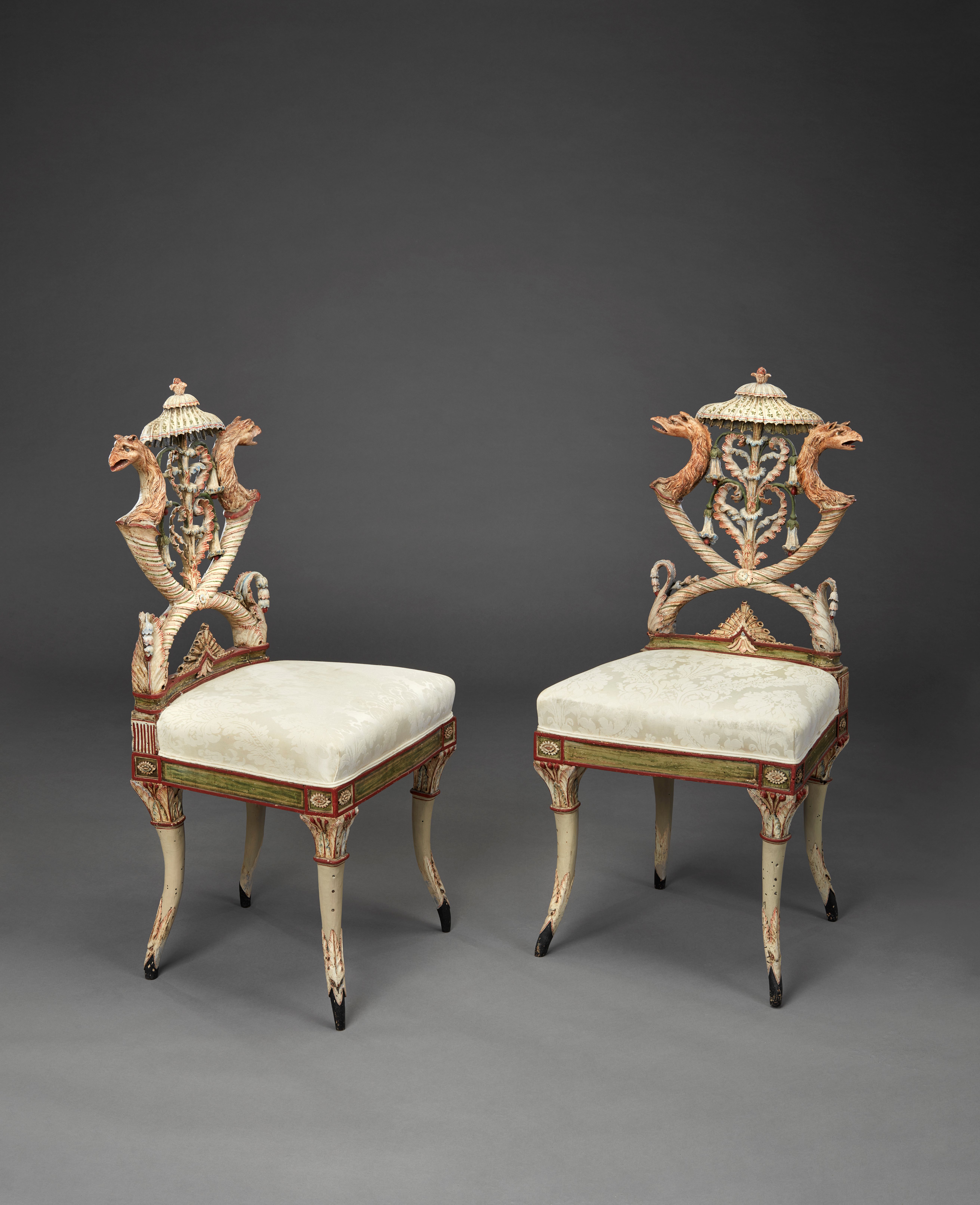
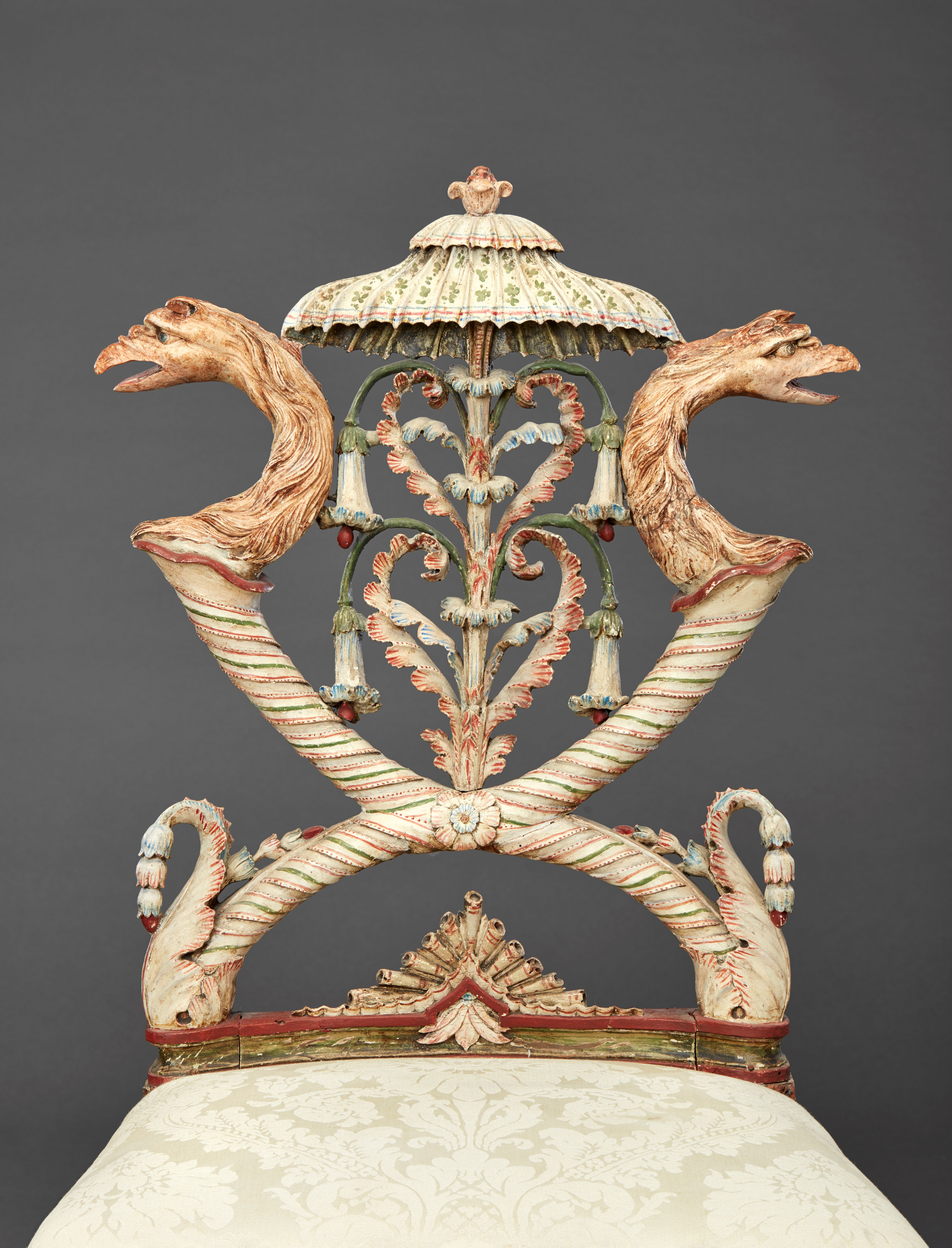
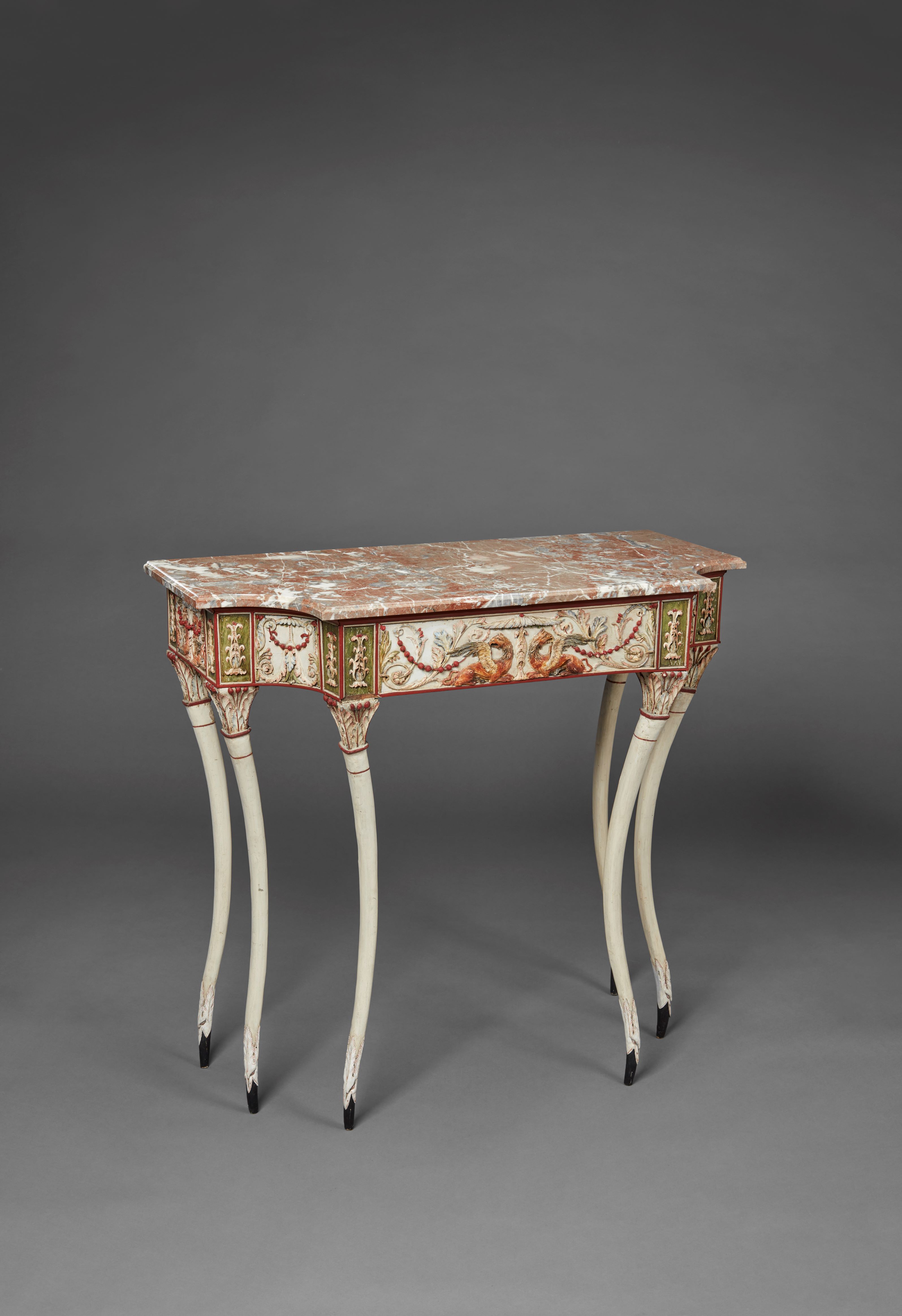
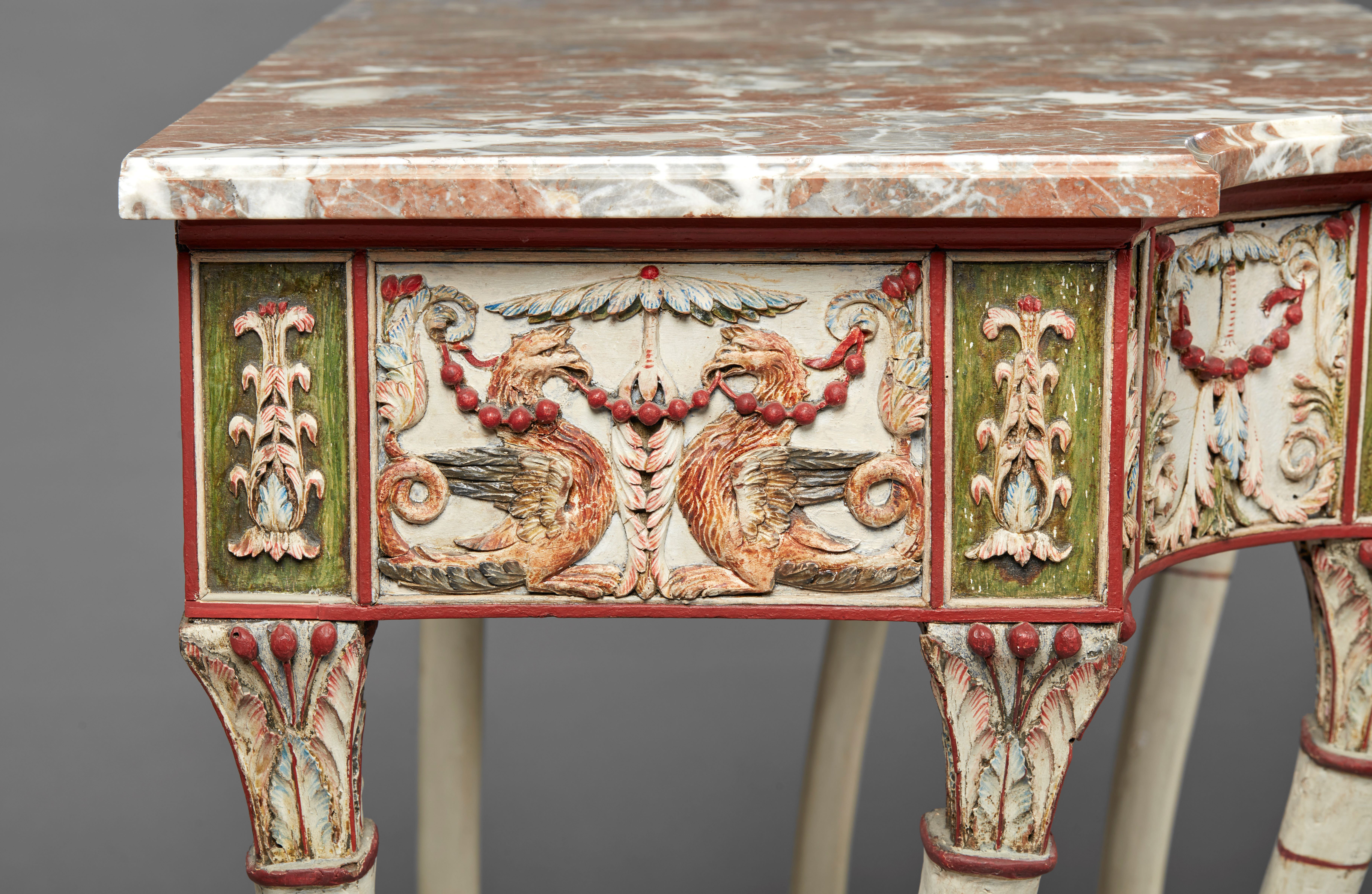
A very rare suite of fantasy furniture after designs by Michelangelo Pergolesi, the two chairs with elaborate Chinoiserie backs, with canopied bells and scrolling dragons, above foliate out turning legs ending in simulated goat’s pad feet. The table, with rouge griotte marble, painted in complementary decoration, with elaborate swags and foliate fountains supported on highly attenuated inward curving legs, tapering to similar painted feet.
This highly distinctive pattern of chair and equally singular design of table are almost certainly inspired by the printed designs of Michelangelo Pergolesi (d. 1801) in his Designs for Various Ornaments, published in fourteen parts between 1777 and 1801. Pergolesi had come to England from Italy and was working with the architect Robert Adam as a stuccoist and decorator alongside Agostino Brunias at Syon House in the 1760s.1
His pattern book became an essential handbook for neo-classical interior decorators in the last decades of the 18th century, providing quantities of alla antica decorative details, such as this ‘Etruscan’ style. Pergolesi’s designs were popular throughout Europe, especially in his native Italy, from where his fanciful and delightful antique designs ultimately originated.
A chair of the same design is in the Cooper Hewitt, Smithsonian Design Museum, New York (inv. no 1924-6-1) and was exhibited in Mr Pergolesi’s Curious Things: Ornament in 18th-Century Britain, an exhibition exploring Pergolesi’s drawings and designs. A triple-chairback settee of the same design but with female figures dividing the chair back, is in The Ringling Museum of Art, Sarasota (inv. no. SN1533). The pair to the present table may be one sold at Sotheby’s Paris, 15 September 2017, lot 32.
Mona Bismarck was a renowned beauty, fashion icon and society hostess. The fashion journalist and editor Diana Vreeland described her ‘unforgettable elegance’ and Diana Mosely, in 1986, wrote that ‘There was never an ugly object in any of Mona & Eddie’s [von Bismarck] houses’. She was married five times: her third husband was the American businessman Harrison Williams (1873-1953), whom she married in July 1926. In New York they lived in a superb townhouse at 94th and Fifth Avenue, and at Oak Point, Bayville, an estate on Long Island. They also kept houses in Palm Beach and on Capri. After Williams’ death in 1953, she married Eddie, Count von Bismarck-Schönhausen (1903-1970), a grandson of the great German Chancellor, Otto von Bismarck. They lived mostly between Paris and Capri, Paris in the autumn and winter at the hotel Lambert ; in Capri, at the villa il Fortino during the spring and summer. Il Fortino was Mona’s favoured home, where she left each autumn with a heavy heart and returned to her delightful garden there the following spring. The villa was constructed over remains of a palace built for the Roman Emperor Tiberius. In 1971, a year after Eddie’s death, she married Umberto de’Martini, who died in a driving accident in 1979. Mona was buried in Long Island in a Givenchy gown designed for her, alongside her husbands Harrison Williams and Eddie von Bismarck. The cream of her collection was bequeathed to museums, including her dresses, which were given to the Metropolitan Museum of Art. Her collections were dispersed in several auctions held in 1986 and 1987, the proceeds of which and the bulk of her estate and the house at 34 avenue de New York, Paris, established the Mona Bismarck Foundation to promote Franco-American friendship through arts and culture. In 2011 the Foundation was renamed the American Center for Arts and Culture and in 2022 the house was sold and the proceeds donated to the American Library in Paris.

Italy, circa 1790
Chairs Height: 38 ¾ in (98.4 cm) Width: 18 in (45.7 cm) Depth: 16 ¼ (41 cm) Table Height: 36 in (91.4 cm) Width: 39 in (99.1 cm) Depth: 19 in (48.3 cm)
Countess Mona Bismarck (1897-1983), villa il Fortino, Capri; sold Sotheby’s Italy house sale, Florence, Palazzo Capponi, 6-7 April 1987

A very rare suite of fantasy furniture after designs by Michelangelo Pergolesi, the two chairs with elaborate Chinoiserie backs, with canopied bells and scrolling dragons, above foliate out turning legs ending in simulated goat’s pad feet. The table, with rouge griotte marble, painted in complementary decoration, with elaborate swags and foliate fountains supported on highly attenuated inward curving legs, tapering to similar painted feet.
This highly distinctive pattern of chair and equally singular design of table are almost certainly inspired by the printed designs of Michelangelo Pergolesi (d. 1801) in his Designs for Various Ornaments, published in fourteen parts between 1777 and 1801. Pergolesi had come to England from Italy and was working with the architect Robert Adam as a stuccoist and decorator alongside Agostino Brunias at Syon House in the 1760s.1
His pattern book became an essential handbook for neo-classical interior decorators in the last decades of the 18th century, providing quantities of alla antica decorative details, such as this ‘Etruscan’ style. Pergolesi’s designs were popular throughout Europe, especially in his native Italy, from where his fanciful and delightful antique designs ultimately originated.
A chair of the same design is in the Cooper Hewitt, Smithsonian Design Museum, New York (inv. no 1924-6-1) and was exhibited in Mr Pergolesi’s Curious Things: Ornament in 18th-Century Britain, an exhibition exploring Pergolesi’s drawings and designs. A triple-chairback settee of the same design but with female figures dividing the chair back, is in The Ringling Museum of Art, Sarasota (inv. no. SN1533). The pair to the present table may be one sold at Sotheby’s Paris, 15 September 2017, lot 32.
Mona Bismarck was a renowned beauty, fashion icon and society hostess. The fashion journalist and editor Diana Vreeland described her ‘unforgettable elegance’ and Diana Mosely, in 1986, wrote that ‘There was never an ugly object in any of Mona & Eddie’s [von Bismarck] houses’. She was married five times: her third husband was the American businessman Harrison Williams (1873-1953), whom she married in July 1926. In New York they lived in a superb townhouse at 94th and Fifth Avenue, and at Oak Point, Bayville, an estate on Long Island. They also kept houses in Palm Beach and on Capri. After Williams’ death in 1953, she married Eddie, Count von Bismarck-Schönhausen (1903-1970), a grandson of the great German Chancellor, Otto von Bismarck. They lived mostly between Paris and Capri, Paris in the autumn and winter at the hotel Lambert ; in Capri, at the villa il Fortino during the spring and summer. Il Fortino was Mona’s favoured home, where she left each autumn with a heavy heart and returned to her delightful garden there the following spring. The villa was constructed over remains of a palace built for the Roman Emperor Tiberius. In 1971, a year after Eddie’s death, she married Umberto de’Martini, who died in a driving accident in 1979. Mona was buried in Long Island in a Givenchy gown designed for her, alongside her husbands Harrison Williams and Eddie von Bismarck. The cream of her collection was bequeathed to museums, including her dresses, which were given to the Metropolitan Museum of Art. Her collections were dispersed in several auctions held in 1986 and 1987, the proceeds of which and the bulk of her estate and the house at 34 avenue de New York, Paris, established the Mona Bismarck Foundation to promote Franco-American friendship through arts and culture. In 2011 the Foundation was renamed the American Center for Arts and Culture and in 2022 the house was sold and the proceeds donated to the American Library in Paris.
Lorem ipsum dolor sit amet, consectetur adipiscing elit. Suspendisse varius enim in eros elementum tristique. Duis cursus, mi quis viverra ornare, eros dolor interdum nulla, ut commodo diam libero vitae erat. Aenean faucibus nibh et justo cursus id rutrum lorem imperdiet. Nunc ut sem vitae risus tristique posuere.