Enquiry form

A Pair of George III Eglomise Inset Cabinets on Stands, Ince and Mayhew
England, circa 1780
Thank you! Your submission has been received!
Oops! Something went wrong while submitting the form.

for enquiries contact: contact@mallettantiques.com | +44 020 7839 4747

England, circa 1780
Each: Height 81 in (205.7 cm) Width 46 in (116.8 cm) Depth 17 ½ in (44.5 cm)




England, circa 1780
Each: Height 81 in (205.7 cm) Width 46 in (116.8 cm) Depth 17 ½ in (44.5 cm)
Property of the Late Captain E.G. Spencer-Churchill (1876-1964), Northwick Park, Blockley, Gloucestershire; Christie's House Sale, 28-30 September 1964, lot 127 (with later oak bases). Anonymous sale; Christie's, London, 30 June 1977, lot 153. With John Keil, London, circa 1978. Acquired from John Keil, London, by Ann and Gordon Getty in 1981. Christie's New York, The Collection of Ann and Gordon Getty:Wheatland, 19 October 2023, lot 209
The Northwick Park Cabinets
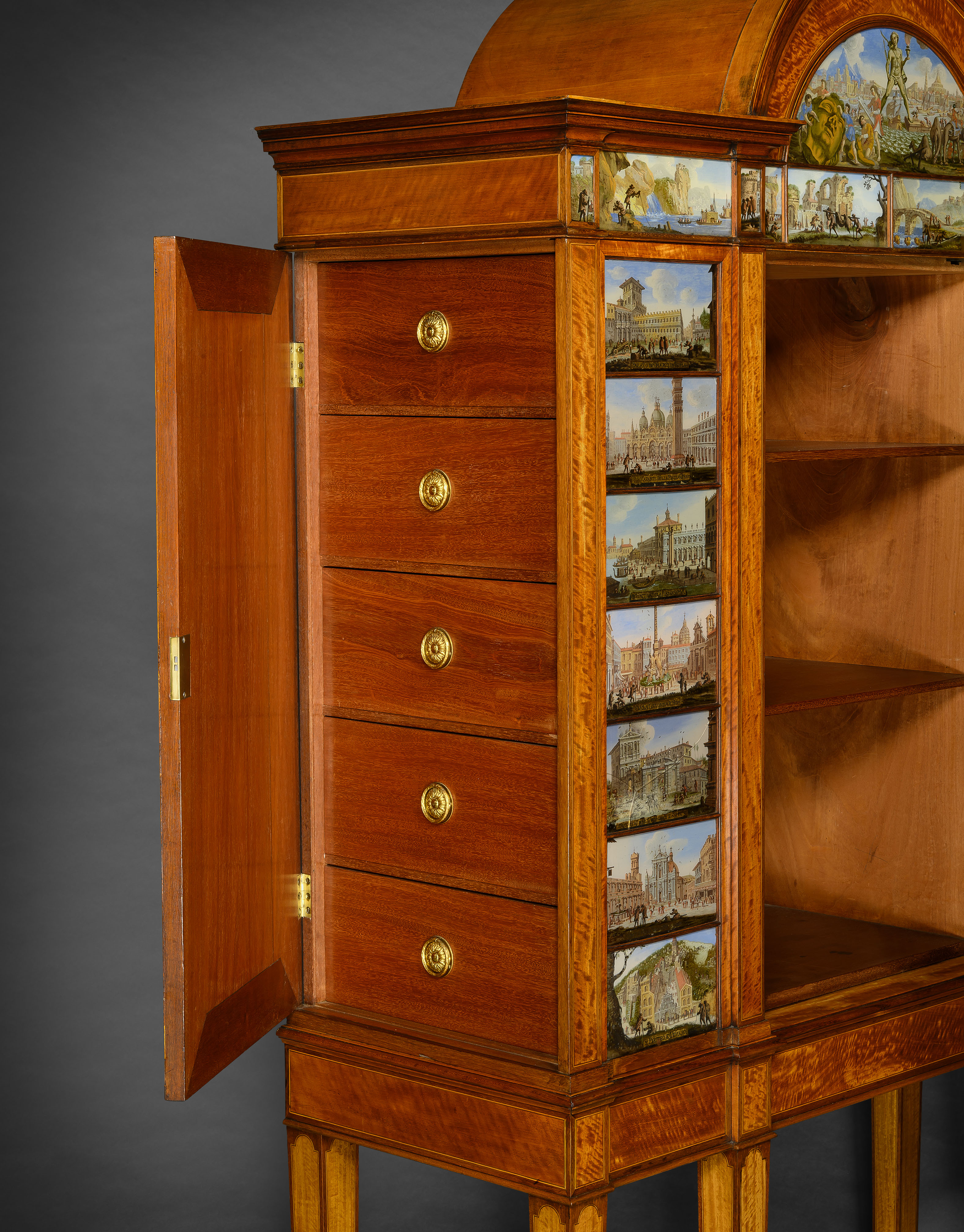
A Pair of George III Satinwood, Amaranth, Mahogany and Italian reverse-painted glass cabinets-on-stands. Each inset with reverse-painted glass panels depicting various Grand Tour landmarks, the sides fitted with doors opening to mahogany-lined drawers, on a conforming stand, the legs and feet replaced.
This exceptional pair of cabinets was designed to display a remarkable series of Italian reverse-glass paintings. They depict buildings and landmarks of the ancient and modern world and were almost certainly acquired as mementoes of the Grand Tour. The paintings follow designs by some of the most widely copied printmakers of their day, among them Maarten van Heemskerck (1498–1574), Maerten de Vos (1532–1603) and Lieven Cruyl (1634–1720).
Firmly attributed to the Golden Square partnership of William Ince and John Mayhew, the cabinets take up the classical theme of the paintings. Domed pediments and temple-like central sections frame an arched panel, flanked by Ionic columns beneath a dentilled frieze. The use of exotic timbers, here satinwood and amaranth, is characteristic of the firm. So is the ingenious inclusion of concealed compartments: discreet doors to either side open to reveal a series of small drawers. From 1764 Ince and Mayhew worked alongside Robert Adam and became known for furniture in the most advanced Neoclassical taste. The present pair relates closely to the Kimbolton Cabinet, one of the most celebrated pieces of English Neoclassical furniture.

England, circa 1780
Each: Height 81 in (205.7 cm) Width 46 in (116.8 cm) Depth 17 ½ in (44.5 cm)
Property of the Late Captain E.G. Spencer-Churchill (1876-1964), Northwick Park, Blockley, Gloucestershire; Christie's House Sale, 28-30 September 1964, lot 127 (with later oak bases). Anonymous sale; Christie's, London, 30 June 1977, lot 153. With John Keil, London, circa 1978. Acquired from John Keil, London, by Ann and Gordon Getty in 1981. Christie's New York, The Collection of Ann and Gordon Getty:Wheatland, 19 October 2023, lot 209

The Northwick Park Cabinets
A Pair of George III Satinwood, Amaranth, Mahogany and Italian reverse-painted glass cabinets-on-stands. Each inset with reverse-painted glass panels depicting various Grand Tour landmarks, the sides fitted with doors opening to mahogany-lined drawers, on a conforming stand, the legs and feet replaced.
This exceptional pair of cabinets was designed to display a remarkable series of Italian reverse-glass paintings. They depict buildings and landmarks of the ancient and modern world and were almost certainly acquired as mementoes of the Grand Tour. The paintings follow designs by some of the most widely copied printmakers of their day, among them Maarten van Heemskerck (1498–1574), Maerten de Vos (1532–1603) and Lieven Cruyl (1634–1720).
Firmly attributed to the Golden Square partnership of William Ince and John Mayhew, the cabinets take up the classical theme of the paintings. Domed pediments and temple-like central sections frame an arched panel, flanked by Ionic columns beneath a dentilled frieze. The use of exotic timbers, here satinwood and amaranth, is characteristic of the firm. So is the ingenious inclusion of concealed compartments: discreet doors to either side open to reveal a series of small drawers. From 1764 Ince and Mayhew worked alongside Robert Adam and became known for furniture in the most advanced Neoclassical taste. The present pair relates closely to the Kimbolton Cabinet, one of the most celebrated pieces of English Neoclassical furniture.
Lorem ipsum dolor sit amet, consectetur adipiscing elit. Suspendisse varius enim in eros elementum tristique. Duis cursus, mi quis viverra ornare, eros dolor interdum nulla, ut commodo diam libero vitae erat. Aenean faucibus nibh et justo cursus id rutrum lorem imperdiet. Nunc ut sem vitae risus tristique posuere.